
Culpeper County Sex Offender Checks
The official starting point is the Virginia Sex Offender and Crimes Against Minors Registry, maintained by the Virginia State Police Criminal Justice Information Services division. It is free to search and does not indicate a public login requirement. A Culpeper County sex offender lookup can use a known name, an address, a ZIP code, or a county filter. Each method answers a different question. A name can locate a known person, while a place search can support awareness around a home, school route, park, or family destination.
The registry is not a full criminal-history product. It presents the convictions and current facts that trigger Virginia registration duties. VSP adds newly received registrations, re-registrations, and verifications each business day, yet a move can occur before the update reaches the state. Read the displayed status and verification details. Compare a photograph, aliases, and physical traits before treating a same-name result as the right person.
Note: A missing result can reflect spelling, geography, an update delay, another jurisdiction, or no legal duty to register.
Choosing a Culpeper Registry Search
Start with the fact you know best. Enter a last name and first name when checking a specific person. For an area check, use a precise address and the live radius control, then repeat the query with Culpeper County or a ZIP code. Town of Culpeper limits do not cover all of Culpeper County, and a geocoder may place an address imperfectly. Near Madison, Orange, Rappahannock, or Fauquier County, repeat the search across the boundary.
Name and map views also require different forms of care. Aliases may appear in a public profile, so a narrow name query can miss a record. A map view may show nearby registered locations, but its pin does not prove a parcel line or show present conduct. List results help identify profiles. Map results help orient a search. Use both when the portal offers them.
Virginia Sex Offender and Crimes Against Minors Registry Searches
Use the live VSP interface because labels and controls may change. The official registry can be intermittently unavailable or protected from automated access. If it does not load, begin at the VSP registry service page and follow its public-search route. Avoid unofficial mirrors, which may omit a status change or show an old address.
- Open the official VSP public registry and read its conditions and misuse warning.
- Select a name or geographic search, then enter the best-known Culpeper details.
- Review both list and map results where offered, checking spelling and nearby boundaries.
- Open the official profile and compare its identity, offense, tier, status, and update fields.
The public interface inventory below records the controls verified in the Culpeper research. Exact radius options were not reliably exposed, so the live dropdown remains the authority.
| Field Label | Type | Required | Notes |
|---|---|---|---|
| Search mode | Tab or control | One mode | Name or geographic search |
| Last Name | Text | Search-dependent | Use known spelling |
| First Name | Text | Optional | Narrows a name result |
| Address and City | Text | Geographic search | Geocoding affects results |
| ZIP Code | Text | Mode-dependent | Use a five-digit ZIP |
| County | Select | Optional | Choose Culpeper when offered |
| Radius | Select | Address search | Confirm options in the live portal |
Culpeper Registry Office and Duties
Virginia law directs registration to the local law-enforcement agency where the person physically resides. Outside the Town of Culpeper, contact the Culpeper County Sheriff's Office at 14023 Public Safety Court, Culpeper, VA 22701, or call 540-727-7520. The county's official Sheriff profile also describes the office's public-safety and jail responsibilities. Registration-unit hours, a direct extension, any local fee, and appointment rules were not published in the sources reviewed, so call before appearing.
For a residence inside the Town, contact the Culpeper Police Department at 740 Old Brandy Road, Culpeper, VA 22701, 540-727-3430, to confirm whether CPD or the Sheriff handles the appointment. Initial registration generally occurs in person within three days after release or a noncustodial suspended sentence. A new Virginia resident also has three days after establishing residence. Name, residence, and employment changes trigger short in-person reporting windows. Electronic-identity changes have a 30-minute rule and may be reported by the method Virginia permits.
Local intake can include form SP-236, fingerprints, palm prints, a photograph, proof of residence, electronic identifiers, work details, and data on owned vehicles, watercraft, or aircraft. Much of that is held for registry administration. Collection by law enforcement does not mean every field becomes public.
Registry Profiles: What They Show
A public profile helps distinguish a true match from a similar name. Virginia law authorizes specific Internet fields, while the public display is narrower than the full agency file. Review the whole record and its current status. Do not copy a profile into a private dossier or assume every item the state collects is visible.
| Name and Aliases | Current name plus former names or aliases reported to VSP |
|---|---|
| Photo and Description | Registry image, age presentation, sex, race, height, weight, and physical traits where shown |
| Registered Location | Residence or a specific habitual location, with work and higher-education information among statutory Internet fields |
| Offense Information | Registration offense, statute or jurisdiction, conviction date, and locality |
| Tier and Status | Tier I, II, or III classification plus compliance or wanted information when published |
| Update Information | Verification or update facts that help readers judge timeliness |
| Possible Other Details | Scars, marks, tattoos, or vehicle descriptors if VSP publishes them |
Social Security numbers, fingerprints, palm prints, DNA data, proof-of-residence copies, and private electronic identifiers are not ordinary public profile fields merely because VSP collects them. The Virginia registration-data statute defines the larger administrative record.
Note: Public display and agency collection are different; a missing field does not show that VSP never received the underlying information.
Culpeper Registry Address Concerns
An address that appears old should be reported, not investigated through a confrontation. First note the official profile URL, displayed status, and update date. Then contact the VSP registry program or the proper local non-emergency agency. The Sheriff is the practical channel outside the Town; CPD can route a Town concern. Call 911 only when there is an immediate danger.
Virginia State Police investigates apparent registration failures under § 9.1-907, and local police or sheriffs may enforce the Registry Act. VSP must physically verify, or cause verification of, an initial registration within 30 days. The statute also calls for later verification for specified registrants outside correctional or community-supervision control and another check within 30 days of an address change. Those duties do not make a citizen's observation conclusive, but they provide an official route for checking it.
Registration Levels and Duties in Virginia
Virginia tiers classify offenses under § 9.1-902; they are not local risk scores assigned by Culpeper County. A time threshold may allow a court petition, but it does not end registration by itself. The Culpeper County Circuit Court at 135 W. Cameron Street handles a qualifying local petition, and the court must make the findings required by state law.
| Virginia Tier | Ordinary Verification | Duration and Visibility |
|---|---|---|
| Tier I | Yearly, including birth month | A person with one Tier I offense may petition after at least 15 years; court removal is required |
| Tier II | Yearly, including birth month | A person with one Tier II offense may petition after at least 25 years; court removal is required |
| Tier III | Four times yearly at three-month intervals | Lifetime duty; ordinary removal under § 9.1-910 is unavailable |
| Defined murder offenses | Quarterly, subject to statute-specific rules | Lifetime duty with statutory removal exclusions |
A failure-to-register conviction can increase verification frequency. Tier I and II registrants then verify twice yearly; Tier III and covered murder registrants may verify monthly. Confinement can toll an otherwise applicable period. The exact offense, conviction history, treatment, restitution, and public-safety findings matter, so the measuring date alone cannot settle eligibility.
Culpeper Registry Alerts Across Borders
VSP form SP-285 provides a notification-request channel for registration or re-registration in the same or a contiguous ZIP code. Find the form through the official VSP forms library. Its ZIP-based coverage differs from a one-time radius query. No verified Culpeper County Sheriff or Culpeper Police registry-alert app was found, so use SP-285, the state portal, NSOPW, and direct agency contacts instead.
For national and county-line coverage, the U.S. Department of Justice NSOPW search combines participating jurisdictions. It supports name and ZIP searches, along with geographic options by address radius, city, ZIP, and county. Its mobile app can offer quarter-mile, half-mile, and one-mile searches where the source jurisdiction permits coordinates. Return to the Virginia profile for the state-specific tier, status, and update record.
The official NSOPW landing screen shows the federal layer used for a Culpeper County sex offender search.
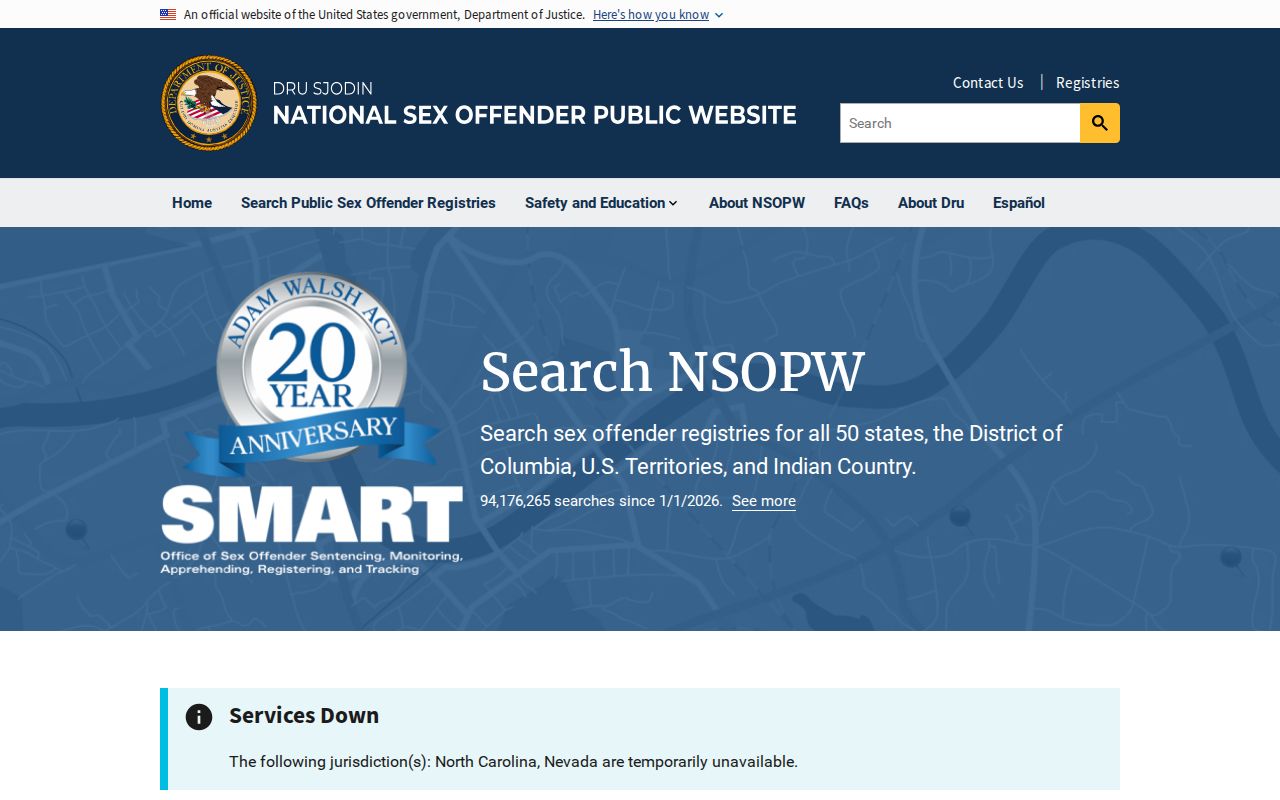
This national view supplements, but does not replace, the Virginia State Police profile and Culpeper reporting channels. NSOPW broadens geography, while the Virginia profile remains the primary record for a Culpeper registrant's state status.
Culpeper Registry Map Limits
A map pin marks registry location data. It does not establish danger, a property line, or a violation of Virginia's residency law. The state's 500-foot restriction is narrow. Section 18.2-370.3 applies only to adults whose qualifying offense facts and dates meet the statute, and it addresses specified child day centers, schools, and certain parks sharing a school boundary and regularly used for school activities.
Whether the rule applies can turn on the conviction, date, measured premises, statutory exceptions, and when a facility was established. A Culpeper County registry map cannot answer those legal and factual questions. Use it for orientation and safety planning. Send a suspected legal violation to law enforcement rather than measuring a screen image or confronting a person.
The official Virginia Registry Act provides the legal framework behind every Culpeper County registry entry.
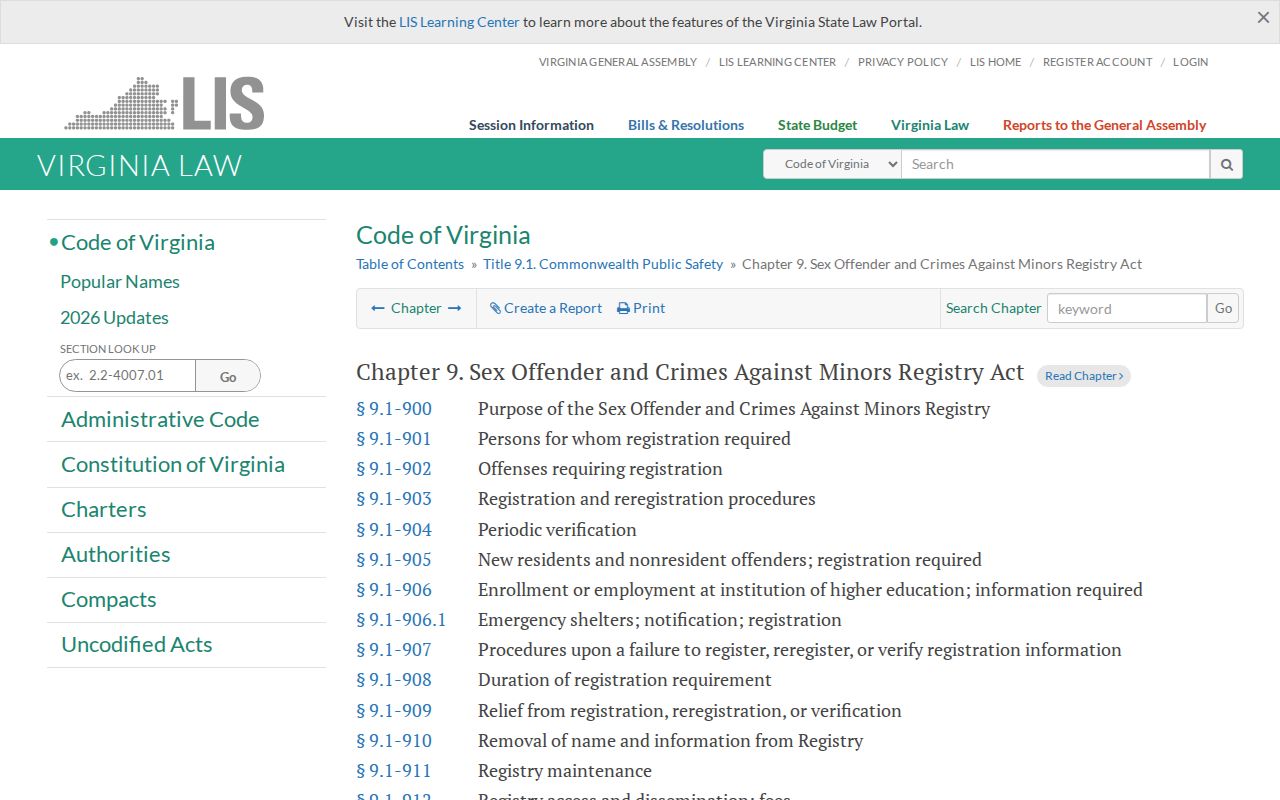
The Act separates registration, public Internet disclosure, verification, reporting, and misuse into distinct legal duties.
Using Registry Information Lawfully
The Virginia registry exists for lawful public-safety awareness and community notification. It does not grant permission to threaten, shame, follow, confront, or intimidate a listed person or household. A profile also cannot establish present danger or predict future conduct. Make safety choices from current facts, and send compliance concerns to VSP, the Culpeper County Sheriff's Office, or Culpeper Police instead of acting as an investigator.
Virginia's Internet-publication law requires VSP to publish specified facts and update newly received registrations, re-registrations, and verifications each business day. Section 9.1-917 addresses misuse. That balance allows public access while preserving criminal penalties for intentional abuse.
Statutory misuse warning: Unauthorized use of Virginia registry information with intent to harass or intimidate is a crime under Va. Code § 9.1-917, punishable as a Class 1 misdemeanor. Under § 18.2-11, that class can carry up to 12 months in jail, a fine up to $2,500, or both. Never confront a listed person.
Registration does not erase other limits or create a general license to discriminate. Likewise, an empty search is not proof that a person has no criminal record or poses no risk. Treat the result as one official state record, confirm its status, and use it only for lawful personal, family, and neighborhood awareness.